Friday, 25 April 2025

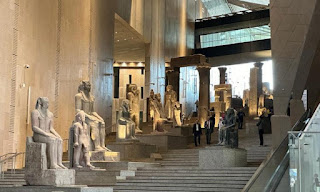
The Grand Egyptian Museum...the most important kings on display in the Grand Staircase


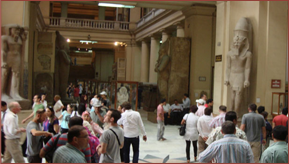
المتحف المصري الكبير - البهو الرئيسي

The Grand Staircase is one of the most important halls of the Grand Egyptian Museum, displaying a collection of the finest and largest heavy artifacts that embody the masterpieces of ancient Egyptian sculpture, including

 The statue of King Seti I

The Grand Staircase at the Grand Egyptian Museum

Statue of King Seti I made of pink granite

One of the kings of the great staircase


King Seti I - Archive

Statue of King Amenhotep III

Amenhotep III - Archive


One of the kings of the great staircase

Statue of King Senusret III or Amenemhat IV

A statue of King Senusret III or Amenemhat IV from the Middle Kingdom, made of quartzite, depicting two princesses. The statue was reused during the reigns of King Ramesses II and King Merneptah.

Kings of the Great Staircase

Statue of King Seti II

Statue of King Seti II made of quartzite from the New Kingdom

Kings of the Great Staircase


Statue of Queen Hatshepsut

Statue of Queen Hatshepsut - Archive

Obelisk of Queen Hatshepsut - Archive


It is worth noting that the obelisk of Queen Hatshepsut is located in the sacred lake area in the Karnak Temples.

One of the kings of the great staircase

One of the kings of the great staircase

One of the kings of the great staircase

For his part, Dr. El-Tayeb Abbas, the museum's director of archaeological affairs, stated that the pieces displayed on the staircase are in accordance with the museum's planned exhibition scenario, which addresses four important themes. The first, displayed at the beginning of the staircase, will embody the royal image through the display of numerous large full-length and half-statues of kings and queens from the Early Period to the Greco-Roman era.

The second theme depicts the concept of worship among ancient Egyptians by displaying the architectural elements specific to the layout of temples during the Old, Middle, New, and Late Kingdoms.

The third section of the Great Staircase addresses the idea of ​​representing kings with various deities through the display of groups of statues of varying sizes depicting deities alone or in company with deities. It also depicts kings performing religious and ritual rites before deities or kings in the form of a hypnotic image.

The fourth and final section of the Great Staircase explores the deceased king's journey to the afterlife and the tools used to protect the deceased king's body during this journey through a collection of coffins, canopic chests, and false doors.


Thursday, 24 April 2025

The Grand Egyptian Museum.... What do you know about the Grand Staircase and the Hanging Obelisk?

 Continuing our coverage of important national events, perhaps the most important of which is the opening of the Grand Egyptian Museum,


Visitors to the new Egyptian Museum will be able to see many things for the first time, not found in any other museum in the world, including:

The Grand Staircase

The Grand Staircase at the Grand Egyptian Museum

It is a staircase that displays a variety of artifacts that belong to the era of the Old Kingdom and up to the Greco-Roman era, according to the chronological order of these unique pieces.

Hanging obelisk

The hanging obelisk at the Grand Egyptian Museum

The Hanging Obelisk is a slender, four-sided stone column with a square base and a small pyramid at its top. This was a feature of ancient Egyptian civilization. Its sides were carved with hieroglyphic inscriptions and royal and religious symbols. The design of the Hanging Obelisk site allows visitors to walk on a glass floor, allowing them to see the underside of the obelisk's base for the first time, If the visitor looks up, he will see, at a distance of 3 meters, the cartouche of King Ramses, which appears below the base of the obelisk suspended on four columns. This is considered the first time that the original archaeological base of the obelisk has been displayed, which no one has noticed in all the obelisk squares in the world.

Source: 

منتدي الشباب المصريين والعرب

Tuesday, 30 November 2021

This Is Wonderful Egypt

Egypt is not only desert, pyramids and camels as many people think, Egypt is a paradise on the earth

Luxury hotels in new Cairo and every where in 


 Luxury hotels on Cairo Nile


Luxury hotels in Alexandria


Hurghada from air

The new city of Galala on the Red Sea mountains in Sukhna

A luxury hotel in New Alamein by the Mediterranean, one of the biggest new smart cities in Egypt

Tahrir square in Cairo 2021

A beautiful scene from the new capital of Egypt, the construction of the business district with its iconic tower, the tallest in Africa

The fascinating resorts of the Red Sea

Sahl Hasheesh resort in hurghada

Cairo university in Giza

The Egyptian museum in Cairo

Cairo at night


Beautiful Alexandria, Montazah palace

New Alamein on the Mediterranean

Al-Azhar masjed - Old Cairo

Red Sea

The national museum of Egyptian civilisation NMEC


Friday, 26 November 2021

The Grand Opening of the Sphinx Avenue in Luxor - THE FULL MOVEI

 Egypt’s President Abdel Fattah El-Sisi ordered that the El-Kebash Road reopening ceremony be a continuation of Egypt’s international event to promote the country’s soft power and ancient civilization.


Thursday, 25 November 2021

Live streaming for El-Kebash Road ceremony


Egyptain President urges El-Kebash Road ceremony to promote Egypt’s soft power, civilization on 25/11/2021 7 pm  (CAT) ; UTC +2

Live streaming:


Thursday, 5 November 2020

Grand Egyptian Museum


Overview
   

The Grand Egyptian Museum holds in trust for Egypt and the World a chronological statement for the ancient history of Egypt over the past 7000 years. Neighboring a timeless wonder, the Giza Pyramids, the new museum is to pay homage to eternal Ancient Egyptian monuments, treasures, and history hosting over 100,000 artifacts, about 3500 of which belong to the famous King Tutankhamen.

The design for the Grand Egyptian Museum was reached as a result of an international architectural competition initiated by the Ministry of Culture on January 7th, 2002. The competition was under the patronage of the UNESCO and supervised by the UIA. The museum complex aims to furnish all its visitors with a uniquely enjoyable, educational, and cultural experience.

The Grand Egyptian Museum will allow Egypt to become a major worldwide hub for Pharonic history and a must-visit place for Egyptologists. The museum aims at taking grasp of the diversity of Egypt's heritage of monuments and arts needed to be shown in one place in one location to maintain and preserve this huge legacy.

The site chosen for the GEM is only 2km from the legendary Pyramids. Nested between the ancient Great Pyramids and the modern city of Cairo, at the junction between dry desert and the fertile floodplain, the Grand Museum is a portal to the past. The Giza plateau Memphis and its Necropolis nominated by UNESCO among the world Cultural Heritage Sites, contains irreplaceable monuments from across time.The museum complex will be built on a plot of land approximately 117 feddans, about 480,000 square meters.

With its unique position on the cusp between the past and the present, the Grand Egyptian Museum will lie at the repository for ancient artifacts that creates an interactive experience for the visitor; it will build a bridge between the past and the future.


Historical Background

GEM
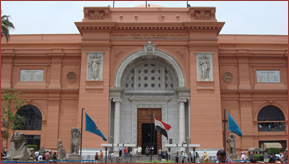
Egyptian Museum


GEM
Egyptian Museum

 
The present Egyptian Museum in Cairo was designed at the end of 19th century and inaugurated on November 15th, 1902.The museum adopted a neo-classic style, keeping with its immediate architectural surroundings and reflecting the classical tendencies of many of the artifacts it was intended to house. The building was designed to facilitate the easy flow of visitors from one gallery to another, while taking into account contemporary standards of air-circulation and natural lighting.
When the museum was inaugurated it had approximately 500 visitors daily, circulating within 15,000 sqm. ; today the visitors’ number reaches 5,000 – 7,000 a day . Back then, the museum housed 35,000 artifacts ; today the museum houses more than 140.000 objects, excluding those currently stored in the basement of the building. Still more objects remain in the warehouses attached to various archaeological sites elsewhere in Egypt.


 With around 2.500.000 visitors annually, over-crowding has become an inevitable problem. Consequently, the Egyptian government has allocated a piece of land, with the great pyramids of Giza as its backdrop, on which to build the Grand Egyptian Museum. The GEM is intended to house more than 100.000 artifacts.

On 4th of February 2002,the foundation stone of the Grand Egyptian museum was laid to announce to the world that Egypt is committed to build a significant cultural monumental and to send a global message that the Egyptian civilization will always be a source of enlightenment.

Mission and Vision

The Mission 

Egypt has been known as the most ancient center of civilization, art and culture. Throughout history, during the Pharaonic, Greco-Roman, Coptic and Islamic periods, even during times of invasion, art has operated as a common denominator. The constant expression of life through art has remained an inherent trait of Egypt and its inhabitants. The Grand Egyptian museum is conceived to be an exemplary manifestation of this trait, exhibiting civilization with all its dynamics: the land of Egypt, kingship and state, daily life, religion and knowledge.

The mission of the museum is to preserve, document, conserve, research, exhibit its collections and educate and entertain its visitors, whether adults or children. The major concern of the museum is to satisfy visitors through serving as a world –class, hospitable and dynamic institute in order to engineer new experiences capable of raising the visitors’ curiosity and including the pleasure of discovery and enjoyment of culture.

The Vision

The unique legacy of this ancient civilization needed to be presented within a single building. This edifice is a repository and a showcase for the development and achievements of Ancient Egypt. But then the question rose "How can one building span the area between heaven and earth?"

Only LIGHT can span this space between Heaven & Earth, and through light, vision is born, that which has guided the Pharaohs and all of creation.

The Grand Egyptian Museum was guided by this vision, a single source; faint yet filled with the strength to glow with the power of a thousand suns. This source was the inspiration to build this edifice and bring about its birth through an exceptional concept and an outstanding design.

The Grand Egyptian Museum a place that allows its visitors a unique experience of going back in time and navigating through the story of Ancient Egypt over the past 7000 years, and enjoying a voyage through one of the richest cultural heritages ever created.


Museum Location


The Grand Egyptian Museum is located only 2 kilometers from the Giza Pyramid plateau that is included in the UNESCO World Heritage Site list, which extends in a north-south direction for about 30 km from Abu Rawash to Dahshour, including the Abu Ghorab, Abu Sir and Saqqara archaeological area. North of the Pyramids plateau is the Hassana Dome, a singular geomorphologic feature designated as a Protected Area.

The area allocated for the Grand Egyptian Museum is about 480,000 sq.m. It exists on a higher hill at the beginning of the Cairo-Alexandria desert Road and is also accessed from the Fayoum Desert Road .


Museum Site With Connection to Pyramids

The Grand Egyptian Museum establishes a strong visual relationship to the Pyramids. In effect, it creates a single site for the Museum and the ancient wonder establishing a kind of formal dialogue. The top of the Museum level will have a wonderful panorama of the three Giza Pyramids without obstacles. Nested between the ancient Great Pyramids and the modern city of Cairo, at the junction between dry desert and the fertile floodplain, the Grand Egyptian Museum is a portal to the past.


While the Museum is organized within the visual axis from the site to the Pyramids , the site organization also describes a relationship to Cairo. From the top of the plateau the path of the Nile Park inscribes a
cone of vision to Cairo creating the opportunity for a viewing point both over the city and the Pyramids. The site acts as the intersection between modernity and antiquity, literally redirecting the visitor from the modernity of Cairo and Alexandria to the ancient heritage of the Egyptians.

Museum Master plan

GEM Landscape Plan

The functional areas and spatial sectors for GEM have been identified with reference to the various activities corresponding to the requirements of users and staff, and to fulfill the objectives of the project. The total area of the development (indoor – outdoor) is estimated to cover 480,000 square meters.
 
The Grand Egyptian Museum is a complex of buildings and landscape with one identity. The Master plan geometry structures the site at all scales from site plan to exhibition show cases, such that navigation within the complex is straightforward. The Landscape displays a number of thematic parks cafes and restaurants that offer entertainment and enjoyable resting places. This concept extends beyond site boundaries as the main building is structured by the sight line from the site to the pyramids. The main building comprises various exhibition spaces, library, mediatheque, education centre, conference centre and retail but is represented externally by one coherent surface-the translucent Serpinski Wall. On approach to the site from Cairo, the Serpinski Wall captures visitors’ attention and will be appreciated with reference to the pyramids. This wall is the iconographic identity for the entire complex.
 
The GEM is designed in such a manner to create a world class building capable of demonstrating the progress, evolution and development of the Egyptian Civilization. The technological infrastructure of the complex allows for the creation of modern archives and a library capable of facilitating the management, maintenance, and preservation of the collection, as well as research-related activities.


Tuesday, 26 April 2011

Nefertari's temple

Nefertari also known as Nefertari Merytmut was one of the Great Royal Wives (or principal wives) of Ramesses the Great.
Nefertari means 'Beautiful Companion' and Meritmut means 'Beloved of [the Goddess] Mut'. She is one of the best known Egyptian queens, next to Cleopatra, Nefertiti and Hatshepsut. Her lavishly decorated tomb, QV66, is the largest and most spectacular in the Valley of the Queens. Ramesses also constructed a temple for her at Abu Simbel next to his colossal monument here.
Nefertari held many different titles, including: Great of Praises (wrt-hzwt), Sweet of Love (bnrt-mrwt), Lady of Grace (nbt-im3t), Great King’s Wife (hmt-niswt-wrt), Great King’s Wife, his beloved (hmt-niswt-wrt meryt.f), Lady of The Two Lands (nbt-t3wy), Lady of all Lands (hnwt-t3w-nbw), Wife of the Strong Bull (hmt-k3-nxt), God’s Wife (hmt-ntr), Mistress of Upper and Lower Egypt (hnwt-Shm’w-mhw).

Family

Although Nefertari’s origins are unknown, the discovery from her tomb of a knob inscribed with the cartouche of Pharaoh Ay has led people to speculate she was related to him. The time between the reign of Ay and Ramesses II means that Nefertari could not be a daughter of Ay and if any relation exists at all, she would be a grand-daughter. It is possible that Nefertari is the daughter of Mutnodjemet, sister of Nefertiti, and possibly daughter of Ay.[citation needed] There is no conclusive evidence linking Nefertari to the royal family of the 18th dynasty however.
Nefertari married Ramesses II before he ascended the throne. Nefertari had at least four sons and two daughters. Amun-her-khepeshef, the eldest was Crown Prince and Commander of the Troops, and Pareherwenemef would later serve in Ramesses II’s army. Prince Meryatum was elevated to the position of High Priest of Re in Heliopolis. Inscriptions mention he was a son of Nefertari. Prince Meryre is a fourth son mentioned on the façade of the small temple at Abu Simbel and is thought to be another son of Nefertari. Meritamen and Henuttawy are two royal daughters depicted on the façade of the small temple at Abu Simbel and are thought to be daughters of Nefertari.
Princesses named Bak(et)mut, Nefertari, and Nebettawy are sometimes suggested as further daughters of Nefertari based on their presence in Abu Simbel, but there is no concrete evidence for this supposed family relation.

Nefertari's temple


Inside Nefertari's temple
Biography
 
Nefertari first appears as the wife of Ramesses II in official scenes during the first year of Ramesses II. In the tomb of Nebwenenef, Nefertari is depicted behind her husband as he elevates Nebwenenef to the position of High Priests of Amun during a visit to Abydos. Nefertari also appears in a scene next to a year 1 stela. She is depicted shaking two sistra before Taweret, Thoth and Nut.
Nefertari is an important presence in the scenes from Luxor and Karnak. In a scene from Luxor, Nefertari appears leading the royal children. Another scene shows Nefertari at the Festival of the Mast of Amun-Min-Kamephis. The king and the queen are said to worship in the new temple and are shown overseeing the Erection of the Mast before Amen-Re attended by standard bearers.
Nefertari appears as Ramesses II’s consort on many statues in both Luxor and Karnak. In Western Thebes, Nefertari is mentioned on a statuary group from Deir el-BAhari, a stela and blocks from Deir el-Medina.
The greatest honor was bestowed on Nefertari however in Abu Simbel. Nefertari is depicted in statue form at the great temple, but the small temple is dedicated to Nefertari and the goddess Hathor. The building project was started earlier in the reign of Ramesses II, and seems to have been inaugurated by ca year 25 of his reign (but not completed until ten years later).
Nefertari’s prominence at court is further supported by cuneiform tablets from the Hittite city of Hattusas (today Boghazkoy, Turkey), containing Nefertari's correspondence with the king Hattusilis and his wife Pudukhepa. She is mentioned in the letters as Naptera.
Nefertari is shown at the inaugural festivities at Abu Simbel in year 24. Her daughter Meritamen is depicted taking part in place of her mother in some of the scenes. Nefertari may well have been in failing health at this point. After her death she was buried in tomb QV66 in the Valley of the Queens.

Monday, 25 April 2011

Memphis

Memphis was the ancient capital of Aneb-Hetch, the first name of Lower Egypt. Its ruins are located near the town of Helwan, south of Cairo.
According to legend related by Manetho, the city was founded by the pharaoh Menes around 3000 BC. Capital of Egypt during the Old Kingdom, it remained an important city throughout ancient Mediterranean history.
It occupied a strategic position at the mouth of the Nile delta, and was home to feverish activity. Its principal port, Peru-nefer, harboured a high density of workshops, factories, and warehouses that distributed food and merchandise throughout the ancient kingdom. During its golden age, Memphis thrived as a regional centre for commerce, trade, and religion.
  
Memphis' map
Memphis was believed to be under the protection of the god Ptah, the patron of craftsmen. Its great temple, Hut-ka-Ptah (meaning "Enclosure of the ka of Ptah"), was one of the most prominent structures in the city.
The name of this temple, rendered in Greek as Aί γυ πτoς (Ai-gy-ptos) by the historian Manetho, is believed to be the etymological origin of the modern English name Egypt.
The history of Memphis is closely linked to that of the country itself. Its eventual downfall is believed to be due to the loss of its economical significance in late antiquity, following the rise of coastal Alexandria. Its religious significance also diminished after the abandonment of the ancient religion following the Edict of Thessalonica.
The ruins of the former capital today offer fragmented evidence of its magnificent past. They have been preserved, along with the pyramid complex at Giza, as a World Heritage Site since 1979. The site is open to the public as an open-air museum.

Location

The ruins of Memphis are 20 km (12 miles) south of Cairo, on the west bank of the Nile. The modern cities and towns of Mit Rahina, Dahshur, Abusir, Abu Gorab, and Zawyet el'Aryan, south of Cairo, all lie within the administrative borders of historical Memphis.
The city was also the place that marked the boundary between Upper and Lower Egypt. (The 22nd city of Upper Egypt and 1st city of Lower Egypt).

History

Memphis became the capital of Ancient Egypt for over eight consecutive dynasties during the Old Kingdom. The city reached a peak of prestige under the 6th dynasty as a centre for the worship of Ptah, the god of creation and artworks. The alabaster sphinx that guards the Temple of Ptah serves as a memorial of the city's former power and prestige.
The Memphis triad, consisting of the creator god Ptah, his consort Sekhmet, and their son Nefertem, formed the main focus of worship in the city.
Memphis declined briefly after the 18th dynasty with the rise of Thebes and the New Kingdom, and was revived under the Persians before falling firmly into second place following the foundation of Alexandria. Under the Roman Empire, Alexandria remained the most important city. Memphis remained the second city of Egypt until the establishment of Fustat (or Fostat) in 641 CE. It was then largely abandoned and became a source of stone for the surrounding settlements. It was still an imposing set of ruins in the 12th century but soon became a little more than an expanse of low ruins and scattered stone.

Sunday, 24 April 2011

Karnak temple, Luxor

The Karnak Temple Complex—usually called Karnak—comprises a vast mix of ruined temples, chapels, pylons, and other buildings, notably the Great Temple of Amun and a massive structure begun by Pharaoh Ramses II (ca. 1391–1351 BC). Sacred Lake is part of the site as well. It is located near Luxor, some 500 km south of Cairo, in Egypt. The area around Karnak was the ancient Egyptian Ipet-isut ("The Most Selected of Places") and the main place of worship of the eighteenth dynasty Theban Triad with the god Amun as its head. It is part of the monumental city of Thebes. The Karnak complex takes its name from the nearby, and partly surrounded, modern village of el-Karnak, some 2.5 km north of Luxor.


The complex is a vast open-air museum and the largest ancient religious site in the world. It believed to be the second most visited historical site in Egypt, second only to the Giza Pyramids near Cairo. It consists of four main parts (precincts), of which only the largest, the Precinct of Amun-Re, currently is open to the general public. The term Karnak often is understood as being the Precinct of Amun-Re only, because this is the only part most visitors normally see. The three other parts, the Precinct of Mut, the Precinct of Montu, and the dismantled Temple of Amenhotep IV, are closed to the public. There also are a few smaller temples and sanctuaries located outside the enclosing walls of the four main parts, as well as several avenues of goddess and ram-headed sphinxes connecting the Precinct of Mut, the Precinct of Amun-Re, and the Luxor Temple.


The Precinct of Mut is very ancient, being dedicated to an Earth and creation deity, but not yet restored. The original temple was destroyed and partially restored by Hatsheput, although another pharaoh built around it in order to change the focus or orientation of the sacred area. Many portions of it may have been carried away for use in other buildings.
The key difference between Karnak and most of the other temples and sites in Egypt is the length of time over which it was developed and used. Construction of temples started in the Middle Kingdom and continued through to Ptolemaic times. Approximately thirty pharaohs contributed to the buildings, enabling it to reach a size, complexity, and diversity not seen elsewhere. Few of the individual features of Karnak are unique, but the size and number of features are overwhelming. The deities represented range from some of the earliest worshiped to those worshiped much later in the history of the Ancient Egyptian culture. Although destroyed, it also contained an early temple built by Amenhotep IV, the pharaoh who later would celebrate a near monotheistic religion he established that prompted him to move his court and religious center away from Thebes. It also contains evidence of adaptations, using buildings of the Ancient Egyptians by later cultures for their own religious purposes.
One famous aspects of Karnak, is the Hypostyle Hall in the Precinct of Amun-Re, a hall area of 50,000 sq ft (5,000 m2) with 134 massive columns arranged in 16 rows. 122 of these columns are 10 meters tall, and the other 12 are 21 meters tall with a diameter of over three meters.

Thursday, 3 March 2011

Tahrir Square, Cairo

Tahrir Square (Liberation Square) is a major public town square in Downtown Cairo. The square was originally called Ismailia Square, after the 19th-century ruler Khedive Ismail, who commissioned the new downtown district's 'Paris on the Nile' design. After the Egyptian Revolution of 1919 the square was called Tahrir (Liberation) Square, but the square was not officially renamed until the Egyptian Revolution of 1952, which changed Egypt from a constitutional monarchy into a republic.
At the centre of Tahrir Square is a large and busy traffic circle. On the north-east side is a plaza with a statue of Ottoman Egypt-era Cairene Omar Makram, and beyond is the masjed Omar Makram (Omar Makram Mosque).
The square is the northern terminus of the historic Qasr al-Ayn Street, the western terminus of Talaat Harb Street, and via Qasr ElNil Street crossing its southern portion it has direct access to the Qasr ElNil Bridge crossing the nearby Nile River.

The area around Tahrir Square includes the Egyptian Museum, the Mogamma government building, the Headquarters of the Arab League building, the Nile Hotel, and the original downtown campus of the American University in Cairo.
The Cairo Metro serves Tahrir Square with the Sadat Station, which is the downtown junction of the system's two lines, linking to Giza, Maadi, Helwan, Elmarg,and other districts and suburbs of Greater Cairo. Its underground access viaducts provide the safest routes for pedestrians crossing the broad
roads of the heavily trafficked square.


Tahrir Square


Tahrir Square 1980
 
Mogamma government building in Tahrir square

Tahrir Square from Google Earth
  • 2011 Egyptian Revolution
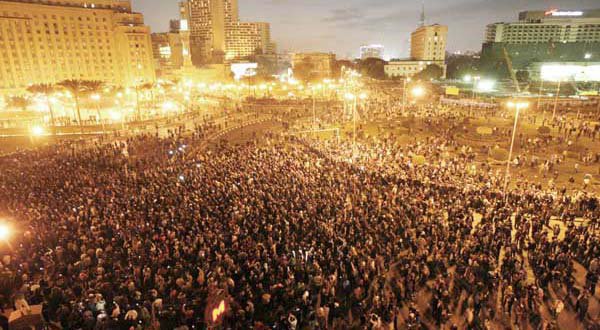
Tahrir Square was the focal point of the 2011 Egyptian Revolution against former president Hosni Mubarak.
Over 100,000 protesters first occupied the square on 25 January, during which the area's wireless services were reported to be impaired.
In the following days Tahrir Square continued to be the primary destination for protests in Cairo.
On 29 January Egyptian fighter aircraft flew low over the people gathered in the square. On 30 January, the seventh day of the protests, BBC and other correspondents reported that the number of demonstrators had grown to at least 200,000, and on 31 January Al Jazeera correspondents reported that the demonstrations had grown to at least 350,000 people. On 1 February, Al Jazeera reported that more than 1 million protesters peacefully gathered in the square and adjacent streets.


More than 1 million people during Egyptian Revolution
The square became established as a focal point and a symbol for the ongoing Egyptian democracy demonstrations. On 2 February violence erupted between the pro-Mubarak and pro-democracy demonstrators here, followed by the 3 February 'Friday of Departure' demonstration, one of the named "day of" events centered in the square.
The 18-day-long revolt centered in the square — led by the young people of Egypt and joined by citizens of all ages, genders, and classes — succeeded in the ouster of Mubarak on Friday 11 February 2011, when the president officially stepped down from office. The announcement, that Mubarak had passed all authority to the Council of the Armed Forces, was made by longtime intelligence chief and new vice president Mr Omar Suleiman. Tahrir Square erupted in a night-long celebration after the twilight announcement, with shouts such as "Lift your head up high, you're Egyptian," "Everyone who loves Egypt, come and rebuild Egypt," and others. The next day Egyptian women and men came to clean up the square, "they came and cleaned up after their revolution," relaying 'projectiles' in the cobblestone paving and removing eighteen day's worth of trash and graffit.

  • See Egyptian Youth cleaning tahrir Square after their revolution


 Egyptian Children cleaning Tahrir Square
Qasr Elnil Bridge's Lions